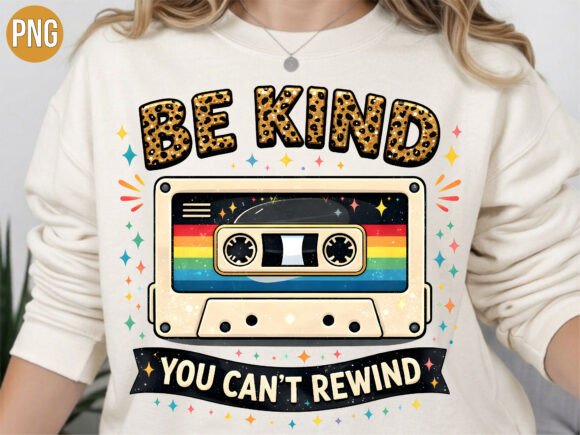
Be Kind You Can’t Rewind Retro Shirt PNG: A Practical Guide for Digital Creators
In the evolving landscape of digital design and print-on-demand entrepreneurship, selecting the right asset is less about aesthetics alone and more about technical compatibility and versatility. The Be Kind You Can’t Rewind Retro Shirt PNG has emerged as a notable resource for creators looking to blend nostalgic typography with meaningful messaging. This specific digital file offers a pre-designed graphic that combines a vintage aesthetic with a modern reminder of mindfulness, packaged in a format ready for immediate application across various media.
For designers, hobbyists, and small business owners, understanding the nuances of this file type—specifically its resolution, background transparency, and intended use cases—is crucial. Unlike vector files or editable templates, a PNG (Portable Network Graphics) file serves a distinct purpose in the creative workflow. This article explores the characteristics of this retro design, compares it to alternative formats, and helps you determine if it aligns with your project requirements.
Understanding the Asset: Resolution and Format
The core value of the Be Kind You Can’t Rewind Retro Shirt PNG lies in its technical specifications. The file is provided in a ZIP archive, which must be extracted before use. Inside, you will find a high-resolution PNG image boasting 300 DPI (dots per inch). This resolution is the industry standard for professional printing. It ensures that when the design is scaled to fit a T-shirt, mug, or poster, the edges remain crisp and the details do not pixelate or blur.
A critical feature of this asset is its transparent background. In digital design, a transparent background allows the graphic to sit seamlessly on top of any colored fabric or surface without an unsightly white box surrounding the text and graphics. This is particularly important for dark-colored garments, which are popular in streetwear and casual fashion. Without transparency, creators would need to manually remove the background using software like Photoshop or GIMP, a process that can be time-consuming and prone to errors if the original file quality is low.
However, it is essential to recognize the limitations of this format. As a raster image, the PNG has fixed dimensions. While 300 DPI provides ample quality for most standard print sizes, you cannot infinitely scale the image up without losing quality, unlike vector formats such as SVG or EPS. Therefore, this asset is best suited for projects where the final print size is known and falls within the recommended dimensions of the source file.
Comparing PNGs to Other Design Formats
When evaluating digital assets for print-on-demand or DIY projects, creators often debate between PNGs, SVGs, and PSD (Photoshop) files. Each format serves different needs, and choosing the wrong one can lead to workflow bottlenecks.
- PNG vs. SVG: SVG (Scalable Vector Graphics) files are ideal for cutting machines like Cricut or Silhouette because they consist of mathematical paths rather than pixels. If your primary goal is to create vinyl decals or heat transfers using a cutting machine, an SVG might be more appropriate. However, for direct-to-garment (DTG) printing or sublimation, a high-quality PNG like the Be Kind You Can’t Rewind Retro Shirt PNG is often preferred because it preserves complex textures, gradients, and distressed effects that vectors sometimes struggle to replicate naturally.
- PNG vs. PSD/AI: Layered files (PSD or AI) offer maximum editability. They allow you to change fonts, colors, and layout elements. If you need to customize the phrase "Be Kind" or alter the retro color palette significantly, a layered file would be superior. The PNG format, by contrast, is a "flat" image. It is ready to use but not easily editable. This trade-off means you gain convenience and speed but lose flexibility.
For users who do not possess advanced graphic design skills or software, the PNG format offers a lower barrier to entry. It requires no knowledge of layers, masking, or vector manipulation. You simply import the file into your design software, position it, and print. This makes it an excellent choice for beginners or those managing high-volume production where speed is essential.
Ideal Use Cases and Application Versatility
The versatility of the Be Kind You Can’t Rewind Retro Shirt PNG extends beyond apparel. Its high-resolution and transparent background make it suitable for a wide array of Print on Demand (POD) products. Understanding where this design shines can help you maximize its utility.
Apparel and Textiles
This is the most common application. The retro typography pairs well with cotton T-shirts, hoodies, and tank tops. The distressed, vintage look of the design complements the natural texture of fabric. Additionally, the design can be applied to tote bags, pillowcases, and aprons. When using sublimation printing, ensure the base material is polyester or a poly-coated substrate to achieve vibrant color retention.
Hard Goods and Accessories
Beyond textiles, the file is ideal for hard goods. Mugs, tumblers, and phone cases benefit from the ultra-crisp 300 DPI resolution. The transparent background ensures the design wraps cleanly around curved surfaces without visible borders. Stickers and decals are another popular option; the PNG can be printed on sticker paper and cut out, or used in digital sticker packs for planners and journals.
Paper Products and Decor
Greeting cards, posters, and journal covers are excellent candidates for this design. The message "Be Kind You Can’t Rewind" resonates well in stationery contexts, offering a motivational element. For scrapbooking enthusiasts, the PNG can be integrated into digital layouts or printed and cut for physical albums. The retro aesthetic adds a layer of nostalgia that appeals to a broad demographic, from Gen Z to older millennials.
Evaluating Fit: When to Choose This Asset
Deciding whether the Be Kind You Can’t Rewind Retro Shirt PNG is the right choice for your project depends on several factors. Consider the following decision matrix:
- Software Compatibility: Ensure your preferred design software supports PNG files. Most major platforms, including Canva, Adobe Photoshop, Illustrator, CorelDRAW, and even basic viewers, support this format. If you are using specialized cutting software, check if it imports PNGs effectively for print-then-cut workflows.
- Design Intent: If you want a plug-and-play solution that retains a specific artistic style, this PNG is ideal. The retro effect, including any grain, fading, or color shifts, is baked into the image. If you prefer a clean, modern, or fully customizable design, you may need to look for vector alternatives or editable templates.
- Production Method: For DTG printing, sublimation, and standard inkjet/laser printing, this file is optimized. For vinyl cutting, it is less suitable unless you are using a print-then-cut method. For large-format banner printing, verify the pixel dimensions of the unzipped file to ensure it meets the size requirements without interpolation.
It is also worth noting the thematic appeal. The phrase "Be Kind You Can’t Rewind" combines a call to action with a metaphorical reference to life’s irreversibility. This dual meaning makes it appealing for mental health awareness campaigns, mindfulness blogs, yoga studios, and educational settings. The retro styling softens the message, making it feel approachable rather than preachy.
Practical Tips for Best Results
To get the most out of your digital purchase, follow these practical steps:
- Unzip Before Use: The file arrives in a ZIP archive. Always extract the contents to a folder on your computer before attempting to upload it to design software. Trying to drag directly from a ZIP file can sometimes cause corruption or loading errors.
- Check Dimensions: Open the PNG in your image viewer to confirm the pixel dimensions. This will help you determine the maximum print size at 300 DPI. For example, a 3000x3000 pixel image can print clearly at 10x10 inches.
- Mockup Testing: Before committing to bulk printing, use digital mockups to see how the retro colors interact with different garment shades. Dark heather grey, navy, and black often enhance the vintage vibe, while white shirts may require a slight adjustment in brightness or contrast to ensure readability.
- License Verification: Always review the license terms associated with the digital file. While many POD assets allow for commercial use, some may have restrictions on mass production or require attribution. Ensuring compliance protects your business from legal issues.
Conclusion
The Be Kind You Can’t Rewind Retro Shirt PNG represents a balanced option for creators seeking high-quality, ready-to-use design assets. Its strength lies in its convenience, technical quality, and aesthetic appeal. While it lacks the editability of vector or layered files, it excels in scenarios where speed and visual fidelity are paramount. By understanding its format limitations and leveraging its strengths in appropriate applications—from apparel to home decor—you can integrate this resource effectively into your creative toolkit. Whether you are launching a new POD store or creating personalized gifts, this file offers a reliable foundation for producing professional-grade results.